Thank you for the feedback you've been sending through over the past few weeks, it's helping to shape exactly what we build next.
More than six weeks into Tranche 2, we're not sitting back to see how it lands; we're listening to how it's playing out for you day to day and iterating the platform to keep meeting your evolving needs. Here's what's shipped recently.
Reliance agreements, built into the platform
Relying on another firm's customer due diligence no longer means a side conversation and a paper agreement sitting outside your workflow. Livesign has created a way for you to seamlessly and securely share AML information – without having to rekey data or take unnecessary extra steps.
The only requirement is that the relying party must have a Livesign account if they don’t already, which of course can be done for free and without any lock-in terms. It’s merely to ensure the AML information can be shared securely between parties.
If you’re the one sharing the information or setting up the reliance arrangement, you can simply now create a ‘reliance agreement’ inside Livesign (auto-generated), send it to another firm for acceptance, and it generates as a document with your AML policy attached. The relying firm can then review the risk profile and policy of your firm before ‘accepting’ the agreement. The platform generates notifications the moment the agreement is proposed, accepted or revoked.
Once the agreement is accepted, the reliance is ‘live’ and CDD records can be shared.
Two details worth knowing: the agreement itself can now be downloaded as a document, and sharing doesn't have to happen upfront — a conveyancer can share CDD with a real estate agent after VOI and AML are finalised, not only before the envelope goes out.
Re-verification: a selfie, not a re-upload
This is a great feature to streamline the VOI and AML process for repeat clients. If someone has already completed a VOI on Livesign, they don't start from scratch next time. A returning client simply completes a quick face check only — no re-uploading a licence or passport, no repeating document capture. It’s a faster and cheaper way to manage your compliance obligations and is an enhanced experience for your clients.
A sharper audit trail
Every envelope now includes a point-in-time AML Report capturing what you knew, and when. At finalisation, you record a formal Proceeding or Not Proceeding decision, so the file shows an actual judgement call rather than just a completed status. If an AML response is edited after submission, a file note is created automatically.
When you’re setting up a new CDD matter and you enter the client’s email address, it will recognise the email and will ask you whether you’d like to conduct a re-verification only.
More precise risk assessment
Client addresses are now checked against medium- and high-risk countries and flagged directly in the assessment. Age sits alongside occupation as a risk factor, and nature of business now provides context across three separate risk categories. Sanctions warnings come with clearer guidance on assessing a match, and finance details are now mandatory. Compliance officers and senior managers can still override an automated rating, with the reason recorded.
Companies & Trusts – more features and improved guidance
A number of improvements have landed here:
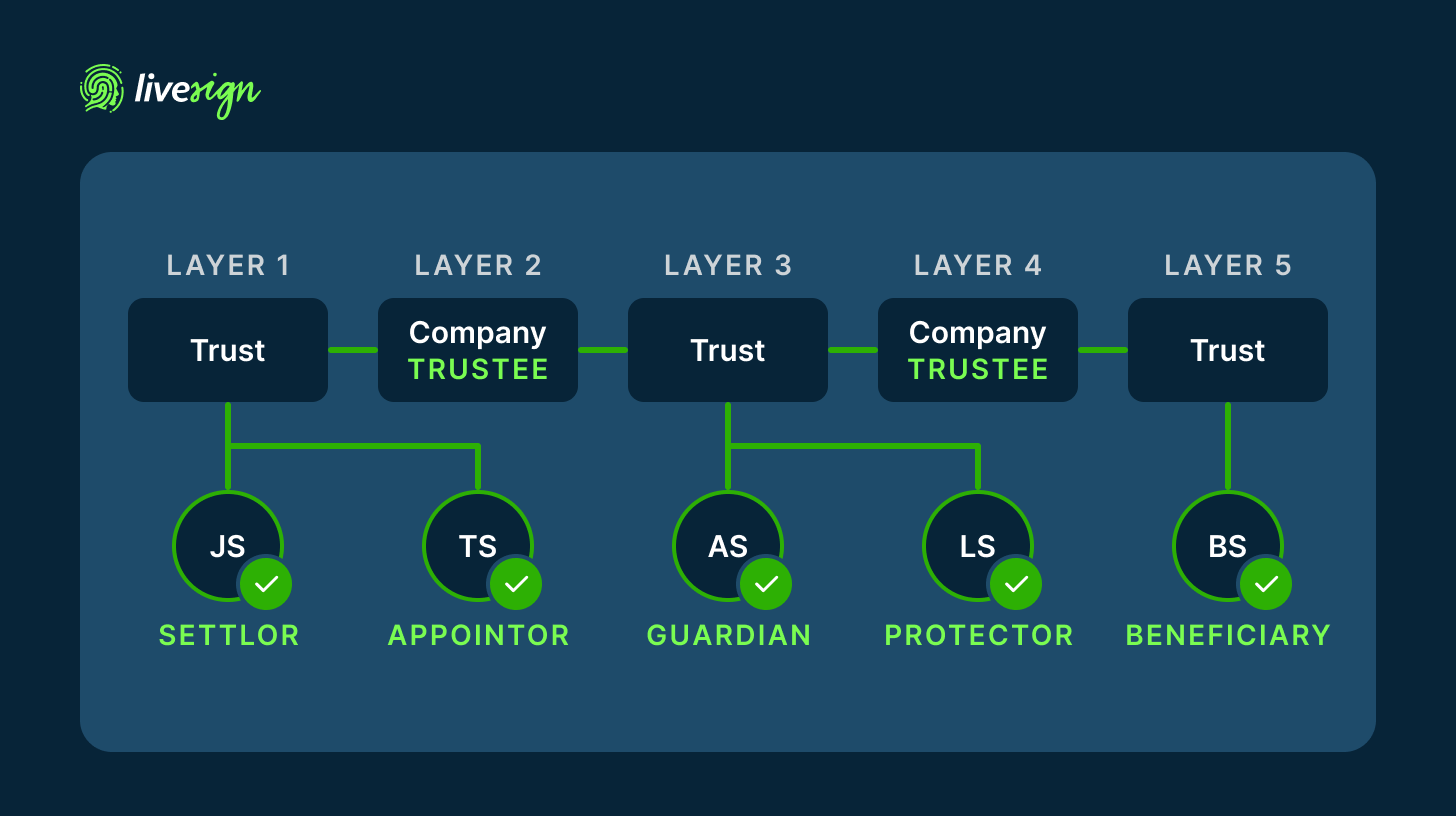
- Corporate trusts are now fully supported, including trusts without an ABN
- Trust questions for property held as trustee now also appear in the individual workflow, not just corporate — when you add a party, you're asked how the buyer or seller is structured, with "Individual trustees on the contract" as one of four options
- A guided party setup asks how the transaction is structured and builds the party structure for you, with collapsible detail forms so screens are less crowded
- If someone is already verified on an envelope and added again, you'll see an "already on this envelope" option so they're not re-entered or charged twice
- Multiple companies and mixed parties (a company and an individual) can now be added on the one envelope.
- You can now enter multiple roles without triggering a second VOI and charge. If a party is already on the envelope and they are entered again, they will see an option “already on this envelope” and once selected, they are not issued a second VOI/charge.
Attaching multiple documents to a CDD file
As a reminder, you can already attach multiple documents to a single CDD matter - just keep selecting the upload option each time.
Coming in September
We're working on our ‘Trust Wizard’ functionality to speed up the process of identifying UBO’s (ultimate beneficial owners) and other key parties, noting that you’ll still need to conduct your own due diligence on this.
We’re also continuing to build ongoing obligations, including continuous monitoring of politically exposed persons, in-envelope guidance when an AML flag is raised, and a source of funds declaration built for buyer CDD.
We’re also working on adding functionality to allow you to request additional documents from your client when you’re setting up a CDD file to send to them. This should streamline the collection and retention of evidence associated with that file.
Plus, you’ll soon be able to customise the email header field in the auto-generated workflow status updates.
Thank you, as always, for your ongoing support of Livesign - your feedback is what keeps this moving in the right direction.



 Solutions OverviewAn overview of our range of solutions and how they work together.Learn more
 Livesign VerifyHow identity verification (VOI) works and when to use it.Learn more
 Livesign DocsHow to send, sign and manage documents digitally.Learn more
 Livesign AMLHow Livesign supports AML/CTF Tranche 2 requirements.Learn more
 About LivesignLivesign’s background, values and why the platform was built for Australian professionals.Learn more
 Who is Livesign?Meet the people behind Livesign and understand the expertise that shapes the platform.Learn more
 How it worksSee how Livesign works in practice; from verifying identity to signing documents and meeting AML requirements.Learn more