Two firms are working on the same matter. One has already met the client and verified their identity. The other would rather not put the client through the same check again.
AUSTRAC's guidance says that is a choice open to you. It also says what follows if you take it. This guide puts that into plain words, so you can see what belongs on your file.
It is about customer due diligence (CDD) under AUSTRAC's guidance. It is general information, not legal advice, and your firm's own AML program and your compliance officer decide how it applies to you. It doesn't cover ARNECC's rules for verifying identity on a property transaction, which are a separate matter.
What AUSTRAC means by relying on another firm
AUSTRAC's record keeping guidance says you may choose to enter into a CDD arrangement with a third-party reporting entity, or a foreign equivalent. It then sets out what you must do if you choose to rely on CDD that firm has carried out.
That part of the guidance is written for the firm that relies. The other firm carries out the checks. You must assess whether it is doing that properly, and record the result.
What the relying firm must assess and record
According to AUSTRAC's record keeping overview, if you choose to rely on CDD another firm has carried out:
- you must complete assessments of whether the third party is properly carrying out the process
- you must record the results
- the record must be prepared within 10 business days after completing the assessment
- you must keep it for 7 years after the record is prepared.
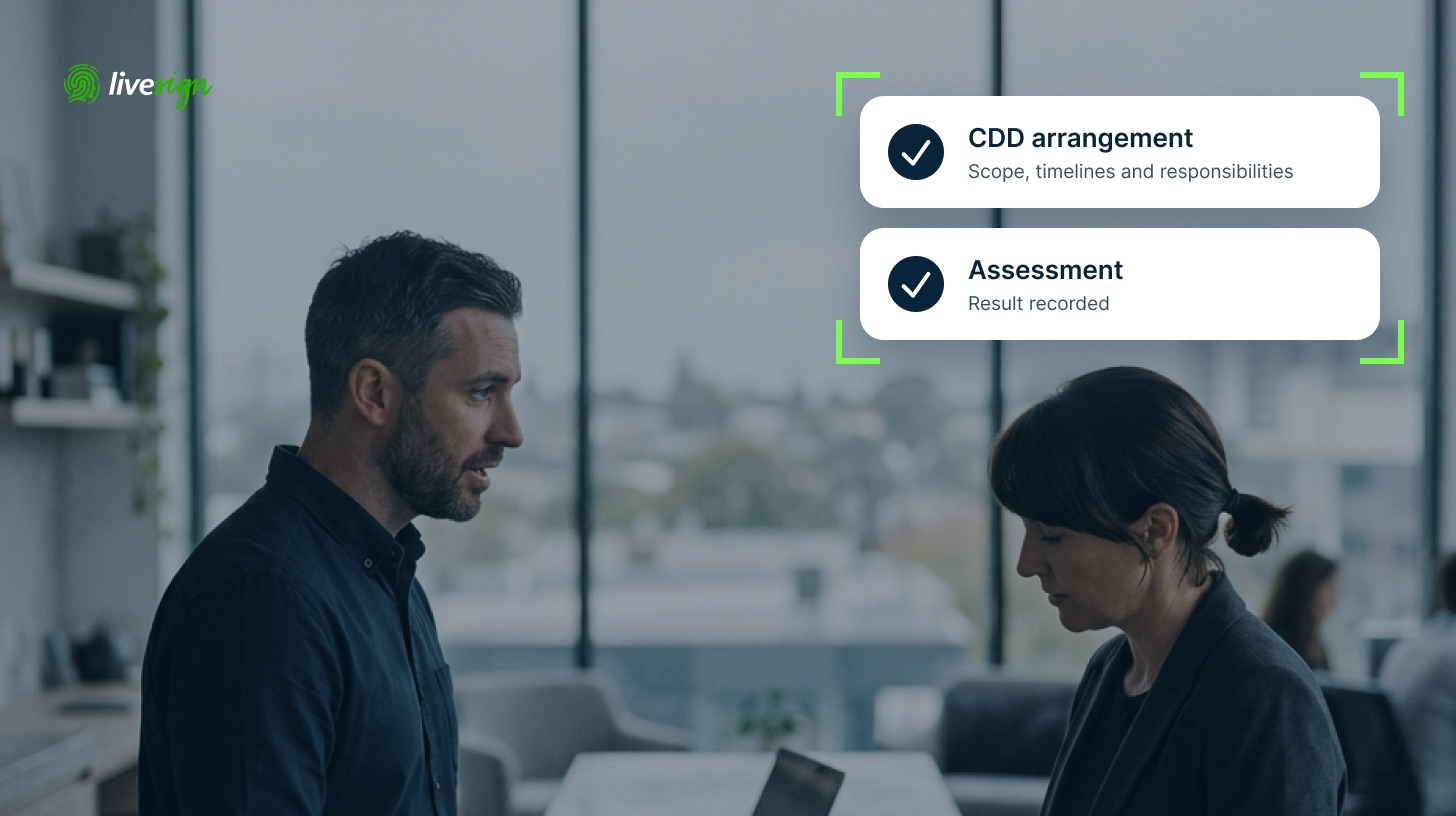
AUSTRAC adds that you must keep a record of the CDD arrangement itself. That record outlines the scope, timelines and responsibilities, and it also serves as a record under the AML program part of the Act (Part 1A). You must keep it in line with the retention periods for CDD records: 7 years from when either an occasional transaction is complete or the business relationship ends.
What those records might look like
AUSTRAC gives examples of records that may show you are meeting your obligations. They are suggestions, not an exhaustive list. For reliance, they include:
- records of CDD procedures conducted through the third-party agreement
- records of periodic assessments of the third party under the arrangement, and any findings or decisions
- the contract or agreement with the third party, outlining scope, timelines and responsibilities.
Notice the wording: "any findings or decisions". The record is not only that you assessed the other firm. It is what you found, and what you decided as a result.
AUSTRAC also says your CDD records must clearly show what customer information you collected, the steps you took to verify it (or to make sure a third party verified it), and the analysis or decision-making that explains why the level of CDD was applied.
The second of those covers verification by a third party. So for a client you did not verify yourself, a file might show the other firm's check there, with your assessment of it alongside. That is one example of how a file could be laid out, not AUSTRAC's wording. Your compliance officer decides what your file shows.
A short check for each firm you rely on
Ask these of every firm you rely on today:
- Is there a record of the CDD arrangement, with its scope, timelines and responsibilities?
- Have you assessed whether that firm is properly carrying out CDD?
- Is the result recorded, within 10 business days of completing the assessment?
- Does the file show the steps taken to make sure the client's identity was verified by that firm?
- Do you know where each record sits, and how long AUSTRAC's retention periods require you to keep it?
If any answer is "I'd have to look", that is the place to start.
Where Livesign fits
The practical steps of reliance between firms sit inside Livesign. In Livesign:
- if you share a matter with the wrong partner firm, you can remove them yourself, without contacting support
- a firm that has relied on another firm's identity check can run a reverification against that same check later, instead of needing a fresh one
- Account Admins can send a reminder to a partner firm that hasn't countersigned a reliance agreement
- a reliance invitation sent to the wrong email address can be cancelled before it is accepted, and a fresh one sent.
None of these steps is the assessment AUSTRAC describes. Assessing the other firm, and recording what you found and decided, is your firm's work. Livesign is one source among your firm's own records, not a substitute for that assessment.
Want to see how reliance between firms works in Livesign? Book a walkthrough at live-sign.com.


 Solutions OverviewAn overview of our range of solutions and how they work together.Learn more
 Livesign VerifyHow identity verification (VOI) works and when to use it.Learn more
 Livesign DocsHow to send, sign and manage documents digitally.Learn more
 Livesign AMLHow Livesign supports AML/CTF Tranche 2 requirements.Learn more
 About LivesignLivesign’s background, values and why the platform was built for Australian professionals.Learn more
 Who we serveBuilt for conveyancers, lawyers and real estate agents. See how Livesign fits your firm.Learn more
 Who is Livesign?Meet the people behind Livesign and understand the expertise that shapes the platform.Learn more
 How it worksSee how Livesign works in practice; from verifying identity to signing documents and meeting AML requirements.Learn more